
Binance October 2026 incident: security-architecture research report
Binance October 2026 incident: security-architecture research report
What is confirmed, reported and inferred about the 29 October 2026 theft from Binance hot wallets, and how SIEM, UEBA, EDR and custody controls could detect or stop a similar attack inside 20 minutes. Prepared for Nabi Zameni, 31 October 2026 (AEDT).
Verification status
| Claim in the brief | Status | Basis |
|---|---|---|
| A Binance theft happened in October 2026 | Confirmed | Binance announcement, 29 to 30 Oct |
| About $6.3B to $6.4B stolen | Confirmed | Binance about $6.3B; TRM $6.36B; Chainalysis about $6.4B; Elliptic $6.43B |
| Compromised engineering workstation | Confirmed, preliminary | Binance: one DevOps engineer's laptop 'may' be involved, plus 'additional points of breach' |
| Abuse of internal automated services | Partly confirmed | Binance: access to a service container that submitted withdrawals; TRM assesses the signing system was made to sign |
| Session-token theft | Not reported | No source mentions it. Treated here as Analysis only |
| Workstations, plural | Not confirmed | Binance names one laptop and unspecified other breach points |
| Private keys or encryption broken | Not supported | Binance found no evidence of a private-key leak |
| North Korea (TraderTraitor) attribution | Reported | TRM high confidence, Chainalysis, Elliptic 'likely'. No government attribution yet; FBI 'aware' |
Executive summary
Starting at 20:05 UTC on 29 October 2026 (07:05 AEDT, 30 October), Binance hot wallets on ten or eleven blockchains sent funds to attacker addresses. Most of the value left in about 20 minutes. It is the largest crypto theft on record, about four times Bybit's February 2025 loss.
No cryptography was broken. Every outbound transaction carried a valid Binance signature. On Ethereum, the attacker submitted 50 pre-signed EIP-7702 authorisations that turned the Binance 14 hot wallet into a sweeper it controlled; other chains saw ordinary signed transfers. Binance says a compromised DevOps laptop gave access to a service container that submitted withdrawals, and that the delegation "did not pass through our normal approval controls".
Analysis: the lesson for defenders is that the signing path, not the key, is the asset. Controls that only protect key material (HSMs, MPC) do not help if a trusted internal service can ask them to sign anything. Detection needs to join endpoint, identity, container, signing-service and on-chain telemetry, and a custody-side policy engine needs authority to pause outflows automatically.
How to read this report
- Confirmed
- Stated by Binance or shown on-chain, with a citation
- Reported
- From analysts or press, not confirmed by Binance or a government
- Analysis
- Our own inference or recommendation
Times are in UTC, as the on-chain sources give them. Melbourne is UTC+11 (AEDT), so 20:05 UTC on 29 October is 07:05 AEDT on 30 October. Dollar figures are US dollars at the time of theft unless noted.
The numbers
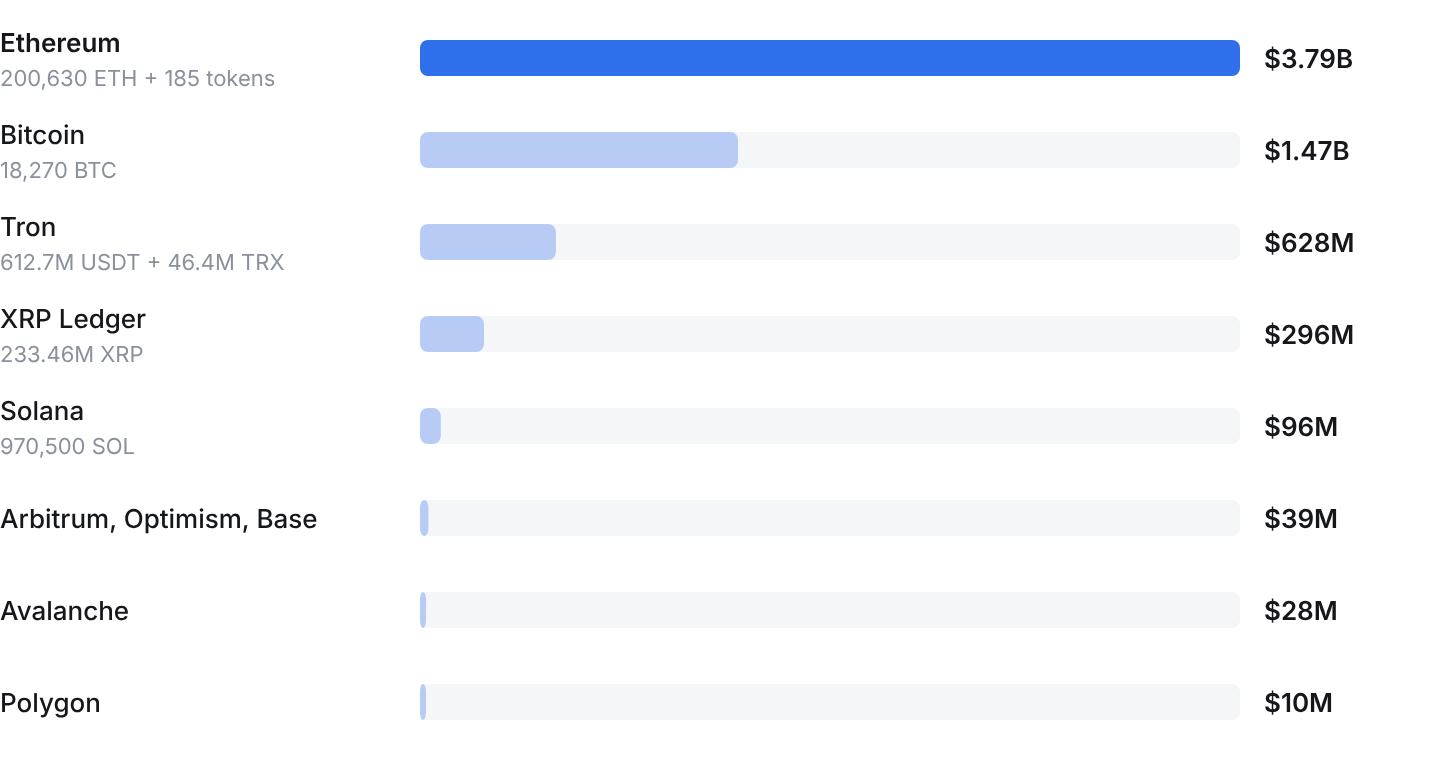
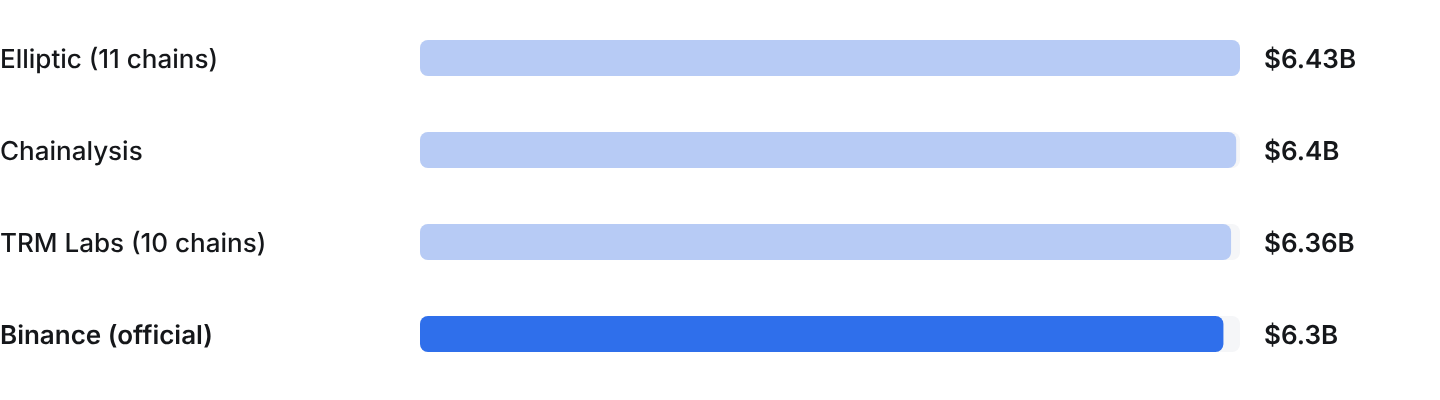
Source: TRM Labs, valued at the moment of each transfer, as of 00:30 UTC 30 October. Totals differ by chain coverage and pricing method; Elliptic excludes $169M it judges to be Binance moving its own funds.
Frozen by issuer (TRM)
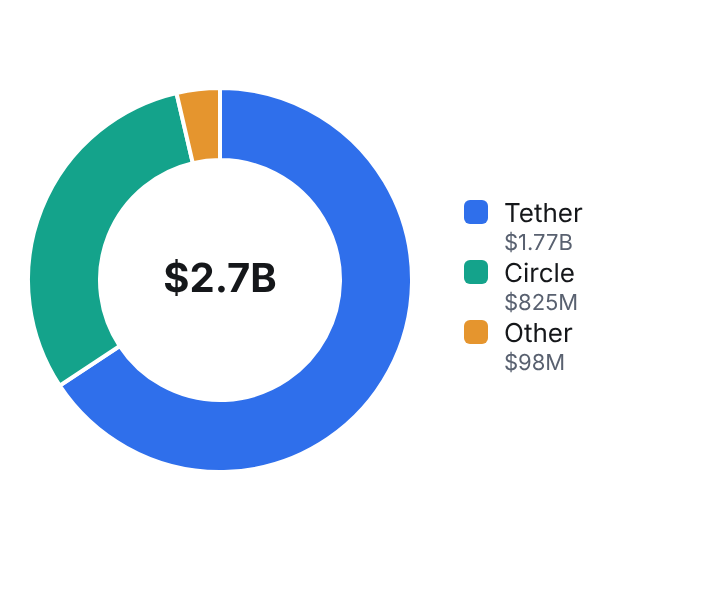
Where the frozen totals stand
| Source | Frozen |
|---|---|
| Binance | about $3B |
| Elliptic | $2.84B |
| Chainalysis | about $2.8B |
| TRM (00:30 UTC) | about $2.7B |
"Other" is Ripple (40.5M RLUSD), World Liberty Financial (27.8M USD1) and the Arbitrum Security Council (about $30M in ETH and ARB). Binance says it has reserved more than $6.34B of company funds to cover losses.
Pillar 1: Incident reconstruction
Confirmed and reported timeline
| Time (UTC) | Event | Tier |
|---|---|---|
| 28 Oct, morning | Operator wallet receives three 0.1 ETH withdrawals from Tornado Cash (TRM, Elliptic) | Confirmed on-chain |
| 29 Oct, early | First attack code deployed and tested on two wallets (TRM) | Reported |
| 29 Oct, 15:59 | Sweeper contract deployed; final version rehearsed about four hours before use (Elliptic) | Confirmed on-chain |
| 20:05 to 20:09 | Five Binance XRP wallets send 233.46M XRP to one address (TRM) | Confirmed on-chain |
| about 20:10 | Solana and Optimism wallets pay out (TRM) | Confirmed on-chain |
| 20:20 | Bitcoin hot wallet sends 18,270 BTC; peel chain starts in the same block (TRM) | Confirmed on-chain |
| 20:20:59 | One transaction carries 50 EIP-7702 authorisations signed by Binance 14, nonces 18,914,775 to 18,914,824 (CoinDesk) | Confirmed on-chain |
| about 20:22 | Tron hot wallet sends 612.7M USDT and 46.4M TRX (TRM) | Confirmed on-chain |
| 20:24:23 | Sweep of Binance 14: 167,464 ETH and 63 tokens incl. 1.615B USDT (TRM, CoinDesk) | Confirmed on-chain |
| 20:24:47 | Binance 16 signs nine transfers to attacker at 2.4 gwei, beside its own withdrawals at 1 gwei (Tibane Labs) | Reported |
| 21:01 / 21:04 | Tether freezes 971.1M USDT; Circle freezes 823M USDC (TRM) | Confirmed on-chain |
| 20:41 to 23:56 | Delegation persists; new deposits swept six more times (TRM) | Confirmed on-chain |
| about 23:05 | Second wave hits Avalanche and Polygon wallets (TRM, Elliptic) | Confirmed on-chain |
| 30 Oct, 00:10:35 | Binance 14 revokes the delegation (CoinDesk) | Confirmed on-chain |
| 30 Oct, 04:51 | ZachXBT reports Binance funds commingled with Bitget-exploit proceeds (via Maborak, Elliptic) | Reported |
| 30 Oct | Binance: DevOps laptop, service container, no key leak; later 'additional points of breach' and self-destructing tooling | Confirmed (Binance) |
The intrusion-to-signing path before 20:05 UTC is not public. Binance has promised a technical post-mortem.
What Binance has said
Binance's initial investigation suggests that the security incident may involve a compromised DevOps engineer's laptop, which allowed an attacker to gain access to a service container and submit unauthorized withdrawal transactions. We have found no evidence of any wallet private key leak.
Binance, Security Incident Update, 30 October 2026
The attacker used a known multi-signature protocol EIP-7702, to obtain on-chain execution approval over a hot wallet. That delegation did not pass through our normal approval controls.
Richard Teng, Binance co-CEO, video on X, 30 October 2026 (via Bitcoin.com News, BBC)
Note: EIP-7702 is code delegation for ordinary accounts ("Set Code for EOAs"), not a multi-signature scheme. Maborak and Bitcoin.com News both flag the wording. The finding that matters is that a normal approval control was bypassed.
Plausible attack model (Analysis)
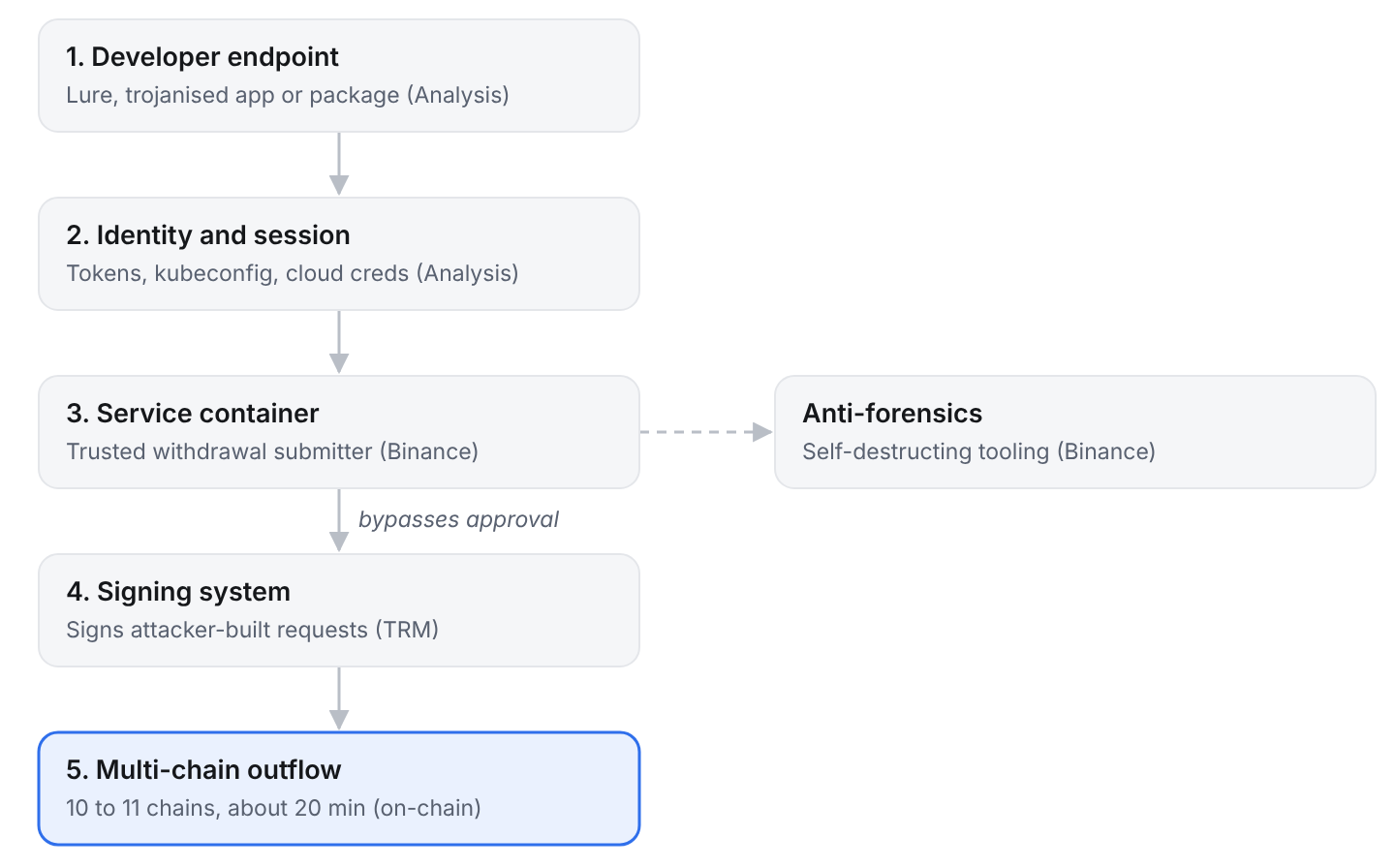
- 1Persistence on a developer endpointAnalysis. TraderTraitor has used crypto-themed lures and trojanised apps (CISA AA22-108A); BBC quotes Aikido on fake job interviews and poisoned dependencies. The vector here is unknown. ATT&CK T1566, T1195.002, T1204.
- 2Credential and session harvestAnalysis. A DevOps laptop typically holds SSO session cookies, cloud CLI tokens and kubeconfig files. Replaying them bypasses MFA. Not reported for this incident. T1539, T1550.004, T1528, T1552.007.
- 3Pivot to a trusted serviceConfirmed in outline by Binance (service container). Exact privileges unknown. T1078.004, T1613, T1609.
- 4Abuse of the signing pathReported by TRM: wallets on different chains, key types and schemes all signed within about 30 minutes, so the signer was instructed rather than a key stolen. The 50-nonce batch suggests signing access was time-limited or had to be requested. T1657.
- 5Pre-staged, fast executionConfirmed on-chain: Tornado-funded operator wallet 36 hours earlier, rehearsed sweeper, then a burst across chains. Self-destructing tooling (Binance). T1070.
Why perimeter and encryption controls did not help (Analysis)
- Perimeter: the attacker operated from inside, through a device and service already trusted.
- Encryption and key storage: keys did not need to leave the HSM or MPC cluster; the signer was asked to sign.
- Transaction approval: the EIP-7702 authorisation is not a transfer, so value or destination checks on withdrawals would not see it.
- Persistence on-chain: once delegated, Binance 14 obeyed the sweeper for nearly four hours with no new signatures.
- Shared blast radius: one signing path served many wallets and chains, so one compromise reached all of them.
Pillar 2: SIEM, UEBA and EDR
Analysis. The preparation phase gave defenders hours; the execution phase gave minutes. Each tool earns its place in a different window.
| Tool | Best window | What it catches here |
|---|---|---|
| EDR | Days to hours before | Malware on the DevOps laptop, credential-file access, token theft from browser stores, tooling that deletes itself |
| UEBA | Hours before | An engineer identity acting off-pattern: new device or ASN, first-time access to signing namespaces, odd hours |
| SIEM | Minutes | Joining endpoint, identity, Kubernetes, signer and chain events into one incident with one owner |
| Signer policy engine | Seconds | Refusing a 7702 authorisation or nonce batch before it is signed |
| On-chain monitor | Seconds to minutes | Delegation code on a treasury address; outflow velocity; off-pattern fees |
Behavioural baselines worth building
| Entity | Baseline | Anomaly |
|---|---|---|
| Engineer identity | Devices, ASNs, hours, namespaces touched | First access to signing or withdrawal namespace |
| Service account | Callers, API verbs, request rate, source pods | New caller, new verb, or call from a human session |
| Signing service | Request types, nonce gaps, fee profile per wallet | 7702 authorisation; many nonces at once; fee off profile |
| Hot wallet | Outflow per 5 min, destination reuse ratio | Outflow above p99 x 3; new destination share spikes |
| Withdrawal pipeline | Ratio of signed tx to approved withdrawal records | Signed tx with no matching approved request |
The last row is the strongest single control: every signature should reconcile to an approved business request ID. GCSA makes the same point about closing the causal chain from endpoint to on-chain transaction.
Dwell time
Confirmed: on-chain preparation began at least 36 hours before the theft. Not public: when the laptop was first compromised. Analysis: SIEM and UEBA shorten dwell time only if signing-service and Kubernetes audit logs reach the SIEM, and if identities in custody namespaces are scored more strictly than general staff.
Pillar 3: Correlation and alerting
Log sources
| Source | Key fields | ATT&CK |
|---|---|---|
| EDR on dev endpoints | Process tree, file deletes, browser credential access | T1566, T1204, T1070 |
| IdP and SSO | Token ID, device ID, ASN, MFA method | T1539, T1550.004 |
| Cloud audit (CloudTrail etc.) | AssumeRole, key and secret reads | T1078.004, T1528 |
| Kubernetes API audit | exec, attach, secrets get, RBAC changes | T1609, T1613, T1552.007 |
| CI/CD and registry | Unsigned image, provenance mismatch | T1195.002 |
| Signing service / HSM / MPC | Request type, wallet, nonce, payload hash, caller | T1657 |
| Withdrawal ledger | Request ID, approver, amount, destination | T1657 |
| Chain nodes / indexers | Type-4 tx, getCode, outflow, fees | T1657 |
Detection opportunities against the 20-minute window
| When | Signal | Response |
|---|---|---|
| T-36 h | Tornado-funded address interacts with any address in your monitoring set | Raise watch level; review signer access |
| T-4 h | Contract deployed that the operator wallet rehearses with (sweeper pattern) | Threat-intel enrichment only; hard to tie to you |
| T-? (unknown) | EDR, token replay, or human exec into signing pod | Kill-chain rule; revoke sessions; isolate host |
| T+0 (20:05) | Several XRP wallets drained to minimum balance in 4 minutes | Velocity rule auto-pauses that chain |
| T+5 to 15 | Same pattern on a second and third chain | Cross-chain rule pauses all hot wallets |
| T+16 (20:20:59) | Signer issues 7702 authorisations; type-4 tx seen | Signer should refuse; watcher alerts at once |
| T+19 (20:24) | Sweep from Binance 14; off-pattern 2.4 gwei fees on Binance 16 | Too late for that wallet; stop later sweeps |
| T+36 onward | Repeat sweeps of new deposits | Pre-approved revocation and deposit rerouting |
Analysis: a velocity rule with authority to pause would have fired within the first five minutes on the XRP Ledger, about 15 minutes before the largest Ethereum loss. This is the clearest missed opportunity visible in public data.
Example rules
Signer (Sigma): Signing-service audit log. Fires on any EIP-7702 authorisation to a delegate outside the allowlist, or on several nonces requested for one wallet in a short window, the pattern seen on Binance 14.
title: Unexpected EIP-7702 authorisation or nonce-range batch from signing service
id: analysis-example-0001        # illustrative, not a published rule
status: experimental
logsource:
  product: custody_platform      # your signing-service audit log
  service: signing_requests
detection:
  delegation:
    request_type: 'eip7702_authorization'
  not_allowlisted:
    delegate_address|expand: '%approved_7702_delegates%'
  nonce_batch:
    distinct_nonces_per_wallet|gte: 3   # computed field over 10 min
  condition: (delegation and not not_allowlisted) or nonce_batch
level: critical
tags:
  - attack.impact
  - attack.t1657                 # Financial Theft
falsepositives:
  - Planned smart-account migration with change ticket
Container exec (KQL): Kubernetes audit plus EDR. A person opening a shell in a signing or withdrawal pod is rare and should be close to zero outside break-glass.
// Human identity runs exec/attach into a production withdrawal or signing pod,
// and the same user's workstation raised any EDR alert in the prior 72 h.
let Window = 72h;
let EdrHits = DeviceAlertEvents            // EDR alerts (e.g. MDE AlertInfo/AlertEvidence)
  | where Timestamp > ago(Window)
  | summarize EdrAlerts = count(), Titles = make_set(Title) by AccountUpn;
K8sAudit                                   // Kubernetes API audit log, ingested to SIEM
| where Verb in ("create") and ObjectRef_Subresource in ("exec","attach","portforward")
| where Namespace in ("withdrawal-svc","signing-svc","wallet-ops")
| where UserType == "human"                // service accounts should never need exec
| join kind=leftouter EdrHits on $left.User == $right.AccountUpn
| extend Severity = iff(EdrAlerts > 0, "Critical", "High")
| project TimeGenerated, User, SourceIP, UserAgent, Namespace, Pod, Severity, Titles
// ATT&CK: T1609 Container Administration Command, T1078.004 Valid Accounts: Cloud
Token replay (KQL): Identity provider sign-in logs. Catches a stolen session or app token reused from a different device or network.
// Session or OAuth token replayed from a new device, ASN or geography
// within the token's lifetime (pass-the-cookie / stolen app token).
SigninLogs
| where TimeGenerated > ago(1d)
| summarize Devices = dcount(DeviceDetail.deviceId),
            ASNs = dcount(AutonomousSystemNumber),
            Countries = make_set(LocationDetails.countryOrRegion)
            by UniqueTokenIdentifier, UserPrincipalName
| where Devices > 1 or ASNs > 1
// ATT&CK: T1539 Steal Web Session Cookie, T1550.004 Web Session Cookie,
//         T1528 Steal Application Access Token
Velocity (SPL): Custody ledger or node data. Per-wallet five-minute outflow against a learned p99 baseline, escalating when two or more chains breach at once.
index=custody sourcetype=hotwallet:outflow
| bin _time span=5m
| stats sum(usd_value) as out_usd dc(dest_address) as dests
        values(chain) as chain by _time wallet_id
| lookup wallet_baseline wallet_id OUTPUT p99_5m_usd allowlisted_dest_ratio
| eval breach=if(out_usd > 3*p99_5m_usd, 1, 0)
| where breach=1
| stats dc(chain) as chains_hit sum(out_usd) as total_usd
        values(wallet_id) as wallets by _time
| where chains_hit >= 2 OR total_usd > 50000000
| eval action="AUTO-PAUSE withdrawals + page custody on-call"
# ATT&CK: T1657 Financial Theft. Thresholds are illustrative.
Kill chain (SPL): Correlates the stage detections above. Three of five stages on one entity within 20 minutes becomes one critical incident instead of five medium alerts.
# Multi-stage correlation: any 3 of 5 stages for one identity,
# device or wallet inside 20 minutes => critical incident
index=notable earliest=-20m
| eval stage=case(
    rule_name="EDR: suspicious process / anti-forensics on dev endpoint", "S1_endpoint",
    rule_name="IdP: token replay new device or ASN",                      "S2_identity",
    rule_name="K8s: human exec into signing or withdrawal pod",          "S3_container",
    rule_name="Signer: off-pattern request (7702, nonce batch, fee)",    "S4_signing",
    rule_name="Chain: hot-wallet outflow above baseline",                "S5_outflow")
| stats dc(stage) as stages values(stage) as seen by entity_key
| where stages >= 3
# T1566/T1195.002 -> T1539/T1550.004 -> T1609/T1613 -> T1657 ; T1070 anywhere
On-chain (pseudo): Independent of internal logs, so it still works if the attacker wipes tooling. Follows TRM's advice to alert on any delegation code at a treasury address.
# On-chain watcher for treasury and hot-wallet EOAs (pseudo-code)
for wallet in TREASURY_EOAS:
    code = eth_getCode(wallet, "latest")
    if code.startswith("0xef0100"):         # EIP-7702 delegation indicator
        delegate = "0x" + code[8:48]
        if delegate not in APPROVED_DELEGATES:
            alert(CRITICAL, wallet, delegate)
            trigger_runbook("sign pre-approved 7702 revocation; pause wallet")
for tx in mempool_and_new_blocks(from_addresses=TREASURY_EOAS):
    if tx.type == 4:                         # set-code transaction
        alert(CRITICAL, "type-4 tx touching treasury wallet", tx.hash)
    if tx.max_priority_fee not in PIPELINE_FEE_PROFILE[tx.from_]:
        alert(HIGH, "fee fingerprint differs from withdrawal pipeline", tx.hash)
All rules are illustrative pseudo-rules written for this report (Analysis). Table and field names are placeholders; tune thresholds on your own baseline. The 0xef0100 prefix is the delegation indicator defined in EIP-7702.
Pillar 4: Mitigation blueprint
Analysis, mapped to published frameworks. Ordered by how directly each control breaks the chain above.
Signing and custody controls
| Control | Why | Basis |
|---|---|---|
| Reject EIP-7702 authorisations unless pre-approved | Removes the Ethereum takeover path | TRM recommendation |
| Treat many-nonce requests as an indicator of compromise | The 50-nonce batch was the tell | TRM recommendation |
| Policy engine outside the request path, with its own data | A trusted caller cannot vouch for itself | NIST SP 800-207 (separate PDP and PEP) |
| Every signature reconciles to an approved request ID | Stops signing on demand | Analysis |
| MPC or HSM quorum that verifies decoded intent, not a hash | Signers see what they sign | Analysis; Elliptic on Bybit parallel |
| Per-wallet and per-chain velocity caps with auto-pause | Bounds loss in the first minutes | Analysis |
| Destination allowlists for hot-to-hot and treasury moves | Blocks new attacker addresses | Analysis |
| Separate signing infrastructure by chain and tier | One breach no longer reaches ten chains | TRM recommendation |
| Pre-signed, tested revocation runbook | Delegation stayed for nearly four hours | TRM recommendation; CoinDesk timeline |
CI/CD and workload hardening
- SLSA Build Level 3 provenance on every image that reaches signing or withdrawal namespaces; admission control rejects unsigned or unprovenanced images.
- No interactive exec or attach into custody pods; break-glass only, two-person approved, time-boxed, recorded.
- Workload identity (short-lived, attested) instead of static service-account secrets, per NIST SP 800-207A.
- Pipelines cannot reach signer APIs; deploy and sign are separate trust domains.
- Secure development practices per NIST SP 800-218 (SSDF), including dependency pinning to blunt poisoned packages.
Just-in-time access and developer workstations
- No standing access to production custody systems; JIT elevation tied to a change ticket and auto-expiring in minutes.
- Phishing-resistant MFA (FIDO2 or passkeys) and device-bound, short-lived sessions so stolen cookies fail elsewhere.
- Privileged-access workstations for custody engineers, separate from email, browsing and interview calls.
- Continuous device posture checks feeding access decisions, per the CISA Zero Trust Maturity Model v2.0.
- For Australian operations: ASD Essential Eight controls (application control, restricting admin privileges, MFA) as a floor.
Financial API gateways
- Mutual TLS and signed requests between withdrawal services and signers, with per-caller scopes.
- Rate and value limits enforced at the gateway, independent of the calling service.
- Anomaly scoring on caller, request type and destination before forwarding to the signer.
- Immutable, off-host audit logs so self-destructing tooling cannot erase the trail.
- Turns a valid signature into one that also needs policy approval
- Caps loss in minutes even if every internal control fails
- Keeps evidence when tooling self-destructs
- Auto-pause will sometimes halt legitimate withdrawals
- Per-chain signer separation adds cost and operations load
- JIT and break-glass slow incident response if not rehearsed
Why Zero Trust matters
Analysis. Every step of the Binance chain relied on implicit trust: a trusted engineer laptop reached a trusted service container, which asked a trusted signer to sign. Zero Trust removes that kind of inherited trust and makes each request prove itself.
Zero trust assumes there is no implicit trust granted to assets or user accounts based solely on their physical or network location (i.e., local area networks versus the internet) or based on asset ownership (enterprise or personally owned).
NIST SP 800-207, Zero Trust Architecture, August 2020
How large organisations implemented it
| Organisation or source | What was done (as published) | Why it matters here | Tier |
|---|---|---|---|
| Google BeyondCorp (;login:, 2014 to 2017) | Removed the privileged intranet; access depends on the user, the device and its state, with internal and external networks treated as equally untrusted. All internal HTTP services moved behind an Access Proxy, with an SSH gateway; the proxy gave a common logging point that helped forensics. Migration ran in stages, using a managed non-privileged network and traffic analysis. | A stolen laptop session on the 'inside' gets no extra reach | Confirmed |
| Google, origin story | Google says the 2009 Operation Aurora attack showed that perimeter-only security left attackers 'wide internal access' once inside, and led it to launch BeyondCorp. | The same failure mode as an inside-the-perimeter pivot | Confirmed |
| Microsoft (Inside Track) | Phishing-resistant MFA everywhere; device health checks (encryption, antimalware, minimum OS via Intune) before access; device management across Windows, Mac, Linux, iOS and Android; pervasive telemetry; least privilege; retiring broad-access VPN. | Device posture plus identity, applied to a very large workforce | Confirmed |
| Coinbase (2019 Firefox 0-day campaign) | Spear-phishing from 30 May 2019, exploit links on 17 June; more than 200 people targeted, about five received the 0-day (CVE-2019-11707 and CVE-2019-11708). EDR flagged Firefox spawning a shell; Coinbase revoked every credential on the machine and locked accounts within hours. | A crypto firm stopping a developer-targeted campaign through EDR and fast credential revocation | Confirmed |
| Coinbase (Single Sign On via Consensus) | Production access requires quorum approval of the permissions, code and config involved, with MFA and an audit trail. | Multi-party approval of privileged access, the gap Binance described | Confirmed |
| US federal government (OMB M-22-09, Jan 2022) | Agencies to meet goals by end of FY2024: phishing-resistant MFA for staff, contractors and partners; a complete device inventory; break perimeters into isolated environments; treat all applications as internet-connected. | A mandated, dated programme for a very large estate | Confirmed |
| CISA Zero Trust Maturity Model v2.0 (Apr 2023) | Five pillars (Identity, Devices, Networks, Applications and Workloads, Data) across four stages (Traditional, Initial, Advanced, Optimal); just-in-time access appears at the Optimal stage. | A yardstick for the phased path below | Confirmed |
| NIST NCCoE SP 1800-35 (final June 2025) | 24 collaborators built 19 example zero trust implementations covering enhanced identity governance, software-defined perimeter, microsegmentation and SASE, mapped to the NIST CSF and SP 800-53r5. | Vendor-built, tested reference builds rather than theory | Confirmed |
| US Department of Defense ZT Strategy (Nov 2022) | Target-level zero trust across DoD by end of FY2027, defined through capabilities and activities. | Shows a multi-year horizon at scale | Reported |
| ASD Modern Defensible Architecture (Feb 2025, updated Oct 2025) | Australian guidance built on 'never trust, always verify', 'assume breach' and 'verify explicitly'; complements the ISM and Essential Eight. The senior decision-maker guide was co-sealed with partner agencies. | The local reference for Australian organisations | Confirmed |
| Sky Mavis after Ronin (Apr 2022) | Post-mortem said its goal was to become a 'zero-trust organization' and that large bridge withdrawals would need human approval. | A crypto firm adopting zero trust after a key-compromise theft | Reported |
How ZTNA maps to the Binance risks
| Risk | Zero Trust control | What it would stop or limit (Analysis) | What it would not stop |
|---|---|---|---|
| Compromised developer laptop | Device posture checked on every request; phishing-resistant MFA; short, device-bound sessions; privileged-access workstation for custody work; all access through an access proxy that logs | Replayed cookies or tokens from another device fail; an unhealthy or unmanaged device loses access; the proxy log shows first-time access to custody apps | Malware acting live on a healthy, enrolled device, using the engineer's own session |
| Internal service-container abuse | No network-level trust; per-request authorisation to the Kubernetes API through an identity-aware proxy; workload identity; microsegmentation; JIT for exec, attach and secrets | Laptop to container is no longer a flat path; human exec into custody pods needs JIT approval; a container can only reach the services its identity allows | A legitimately authorised container sending well-formed but malicious requests |
| Signing-system misuse | Only named workloads with attested identity can reach the signer; mutual TLS; per-caller scopes | Narrows who can talk to the signer and records every call | What the signer agrees to sign. That needs the separate policy engine: 7702 rejection, request-ID reconciliation, nonce and velocity caps |
Phased implementation path
Analysis, aligned to CISA ZTMM v2.0 stages and the ASD Modern Defensible Architecture. Durations depend on estate size; the metrics are suggested targets, not benchmarks from any source.
| Phase | Scope | Key controls | Success metrics | ZTMM stage |
|---|---|---|---|---|
| 0. Baseline | All users, devices, apps, workloads and data flows; custody paths first | Asset and identity inventory; map who and what can reach signers; central logging | 100% of devices and service accounts inventoried; every signer caller known | Traditional to Initial |
| 1. Identity | Workforce, admins, contractors | Phishing-resistant MFA (FIDO2 or passkeys); retire SMS and push for admins; conditional access | Phishing-resistant MFA for 100% of admins, then all staff | Initial to Advanced |
| 2. Devices | Laptops, privileged workstations | Managed devices only; posture (encryption, EDR, OS level) checked at sign-in and during sessions; PAWs for custody engineers | No unmanaged device reaches production; EDR coverage 100% | Advanced |
| 3. Access proxy (ZTNA) | Internal web apps, SSH, Kubernetes API, admin consoles | Identity-aware proxy in front of every app; retire broad VPN; device-bound short sessions; full request logging to SIEM | Broad VPN removed; all admin paths behind the proxy; token replay alerts tested | Advanced |
| 4. Workloads | Clusters, CI/CD, service-to-service traffic | Workload identity; microsegmentation; JIT and two-person approval for exec and secrets; SLSA L3 provenance and admission control | Zero standing human access to custody namespaces; 100% provenance on custody images | Advanced to Optimal |
| 5. Custody and continuous evaluation | Signers, HSM or MPC, hot wallets | Independent policy engine; request-ID reconciliation; 7702 and nonce-batch rejection; velocity auto-pause; red-team drills | Every signature reconciles to an approved request; auto-pause tested quarterly | Optimal |
How security controls evolved
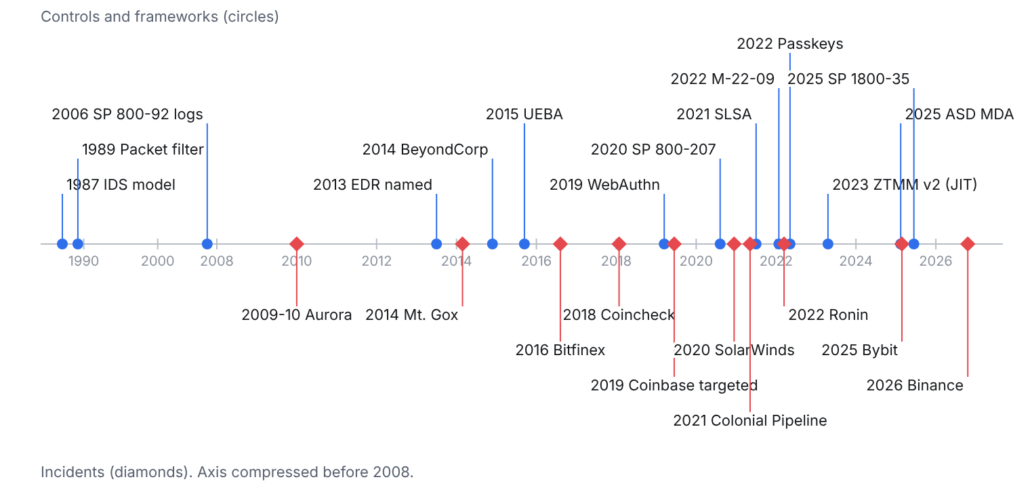
Each generation of controls answered the attacks of its time, and attackers moved to the next gap. The timeline puts dated, cited milestones above the axis and incidents below it. The tables give the sources and the tier for each.
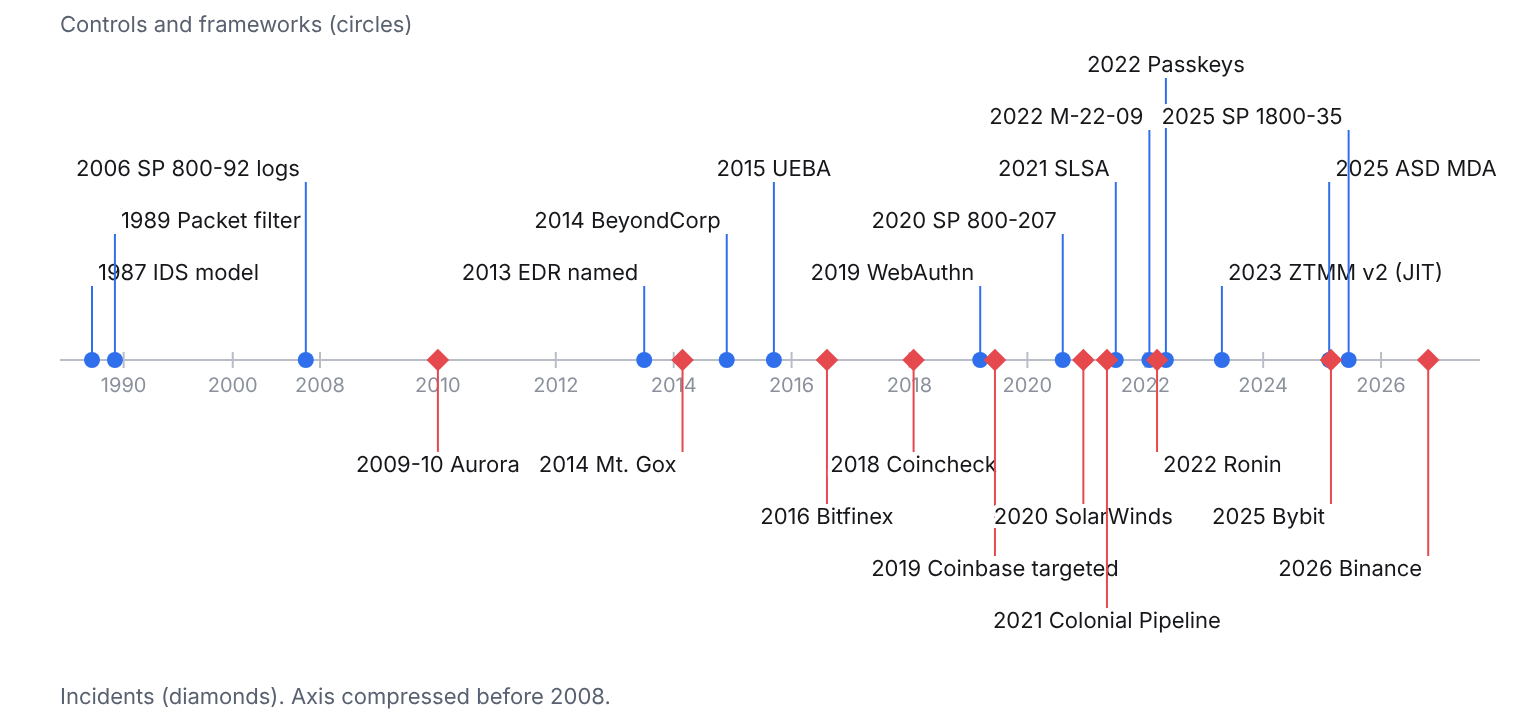
Controls and what they addressed
| Year | Control or milestone | Attack class it addressed | Linked incident | Tier |
|---|---|---|---|---|
| 1987 | Intrusion detection: Denning, 'An Intrusion-Detection Model' (IEEE TSE) | Misuse and anomalous behaviour on systems; the root of IDS/IPS and later UEBA | Confirmed | |
| 1989 | Packet-filtering firewall: Mogul, screend (DEC WRL, USENIX) | Unwanted inbound network traffic at the boundary | Aurora 2009: Google says its walls left 'wide internal access' once breached | Confirmed |
| 2006 | Log management: NIST SP 800-92 (the basis SIEM builds on) | Missing or scattered evidence; slow detection | Bitfinex 2016: attacker deleted credentials and logs (DOJ) | Confirmed |
| 2013 | EDR: Gartner's Chuvakin names 'endpoint threat detection and response' (EDR by 2015) | Malware and hands-on-keyboard activity on endpoints | Coinbase 2019: EDR caught the 0-day chain | Confirmed |
| 2014 | BeyondCorp (;login:, December 2014) | Lateral movement from a trusted internal network | Aurora 2009 (Google's stated trigger) | Confirmed |
| 2015 | UEBA: Gartner market guide widens UBA to users and entities | Valid accounts used abnormally; insiders | Reported | |
| 2019 | FIDO2: W3C WebAuthn Level 1 Recommendation (4 March) | Phishing of passwords and one-time codes | Colonial 2021: legacy VPN account without MFA | Confirmed |
| 2020 | NIST SP 800-207 Zero Trust Architecture (August) | Implicit trust based on network location | Confirmed | |
| 2021 | SLSA announced by Google (16 June); v1.0 on 19 April 2023 | Tampered builds and artefacts in the supply chain | SolarWinds 2020: trojanised Orion update (CISA AA20-352A) | Confirmed |
| 2022 | OMB M-22-09 (26 January): phishing-resistant MFA mandate | Credential phishing at government scale | Confirmed | |
| 2022 | Passkeys: Apple, Google and Microsoft commit (5 May) | Phishing, at consumer scale | Confirmed | |
| 2023 | CISA ZTMM v2.0 (April), JIT at the Optimal stage | Standing privilege and stale access | Ronin 2022: allowlist never revoked | Confirmed |
| 2025 | NIST SP 1800-35 final (June); ASD Modern Defensible Architecture (February) | Turning zero trust from principle into tested builds and national guidance | Confirmed |
MFA itself is much older than this list; the dated milestones above are the phishing-resistant forms. Bybit's attacker reused a live AWS session token and bypassed MFA, so MFA without device-bound sessions is not enough.
Major exchange and custody hacks
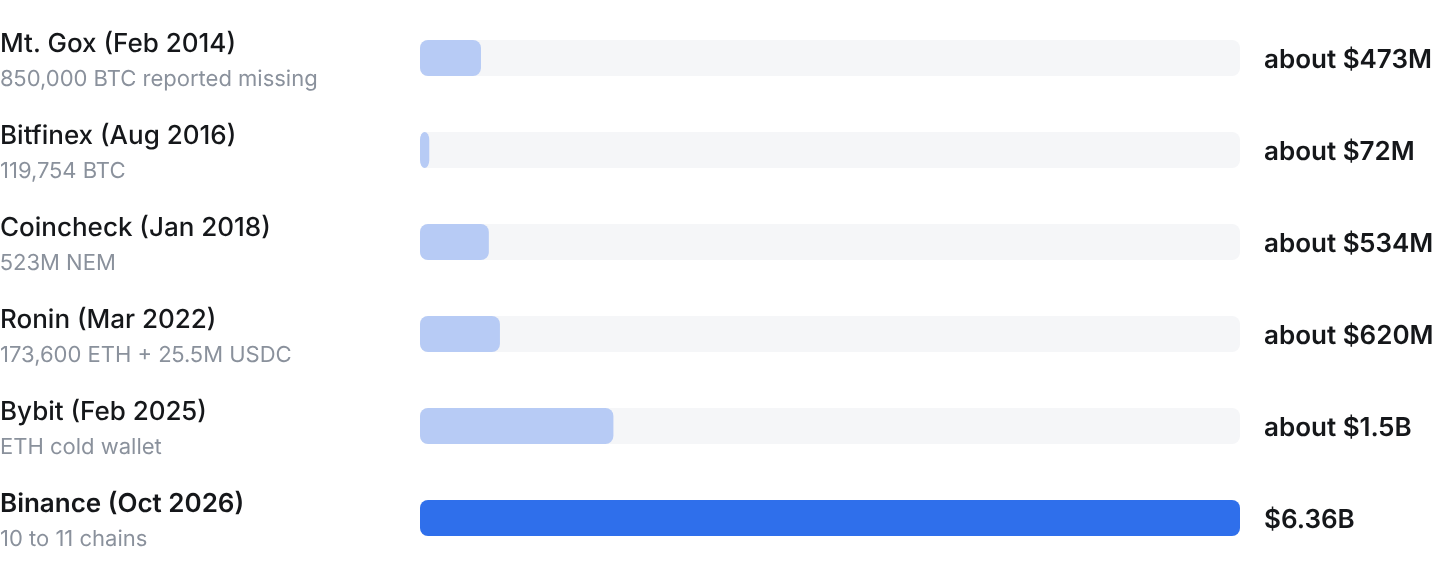
US dollars at the time of each event, as reported then. Bitfinex's 119,754 BTC was valued at over $3.6B when the DOJ recovered most of it in 2022.
| Date | Incident | Amount | What happened | Tier |
|---|---|---|---|---|
| 28 Feb 2014 | Mt. Gox (Tokyo) | 850,000 BTC reported missing, about $473M; about 200,000 later found in an old wallet | Filed for bankruptcy and blamed hackers and system weaknesses. The exact mechanism is still disputed. | Confirmed (Reuters, TechCrunch) |
| 2 Aug 2016 | Bitfinex | 119,754 BTC, about $72M at the time | Hacker breached Bitfinex's network, authorised more than 2,000 transactions, then deleted credentials and log files. | Confirmed (DOJ plea) |
| 26 Jan 2018 | Coincheck (Tokyo) | 523M NEM, about ¥58B or $534M | Malware on an employee device; remote access to the NEM server; private key stolen. The NEM was held in an internet-connected hot wallet. | Confirmed (Coincheck, CNBC) |
| 23 Mar 2022 (found 29 Mar) | Ronin bridge (Sky Mavis) | 173,600 ETH and 25.5M USDC, about $620M | 5 of 9 validator keys: four Sky Mavis keys via spear-phishing, a fifth via an Axie DAO allowlist never revoked. No outflow monitoring, so it was found six days later. FBI attributed it to Lazarus. | Confirmed (Sky Mavis, FBI); fake job offer Reported |
| 21 Feb 2025 | Bybit | About $1.5B | Safe{Wallet} developer Mac compromised on 4 Feb via a malicious Docker project; stolen AWS session token used to bypass MFA; JavaScript in Safe's S3 bucket altered the cold-wallet transaction at signing. FBI attributed it to TraderTraitor. | Confirmed (FBI, Safe); details Reported (Mandiant via Sygnia) |
| 29 Oct 2026 | Binance | $6.3B to $6.43B | DevOps laptop, service container, signer abused, EIP-7702 delegation. See Pillar 1. | Confirmed in outline |
Which controls would have stopped or limited each (Analysis)
| Incident | Would likely have stopped | Would have limited | Would not have helped |
|---|---|---|---|
| Mt. Gox 2014 | Unclear, as the cause is disputed | Cold storage for most funds; frequent on-chain reconciliation of balances against the ledger | A perimeter firewall alone |
| Bitfinex 2016 | Independent policy engine on withdrawals that the attacker's access could not change | Velocity caps on 2,000+ transfers; immutable off-host logs; SIEM correlation | Encryption of keys at rest, since the platform itself signed |
| Coincheck 2018 | ZTNA and segmentation so a staff device has no route to the wallet server; keys in an HSM or multisig | EDR on staff devices; cold storage | IDS signatures for a remote-access tool already inside |
| Ronin 2022 | JIT access with expiry (the allowlist would have lapsed); independent validator operators | Outflow monitoring with auto-pause (loss went unseen for six days); phishing-resistant MFA and EDR on engineers | More validators run by the same organisation |
| Bybit 2025 | Device-bound sessions or ZTNA posture so the stolen AWS token failed off the developer's Mac; signed, provenance-checked front-end artefacts (SLSA) with integrity checks | Independent transaction decoding on the signer device; JIT for S3 write access | Standard MFA, which the session token bypassed |
| Binance 2026 | Signer policy engine rejecting unapproved 7702 authorisations and nonce batches | Velocity auto-pause in the first five minutes; ZTNA and JIT on the laptop-to-container path; per-chain signer separation | HSM or MPC key protection alone, since no key was stolen |
The pattern across a decade: attacks moved from the network edge, to endpoints, to identities and sessions, to the build and signing path. Each control in the timeline still matters, but none is enough without the one after it.
Key gaps and open questions
- No post-mortem yet. Binance has not said how the laptop was compromised or what the other breach points were.
- Session-token theft is not reported by any source. It appears here only as a plausible step.
- How the signing system was made to sign, and why approval controls were skipped, is unexplained.
- Attribution to TraderTraitor is analyst-led. Elliptic notes the Bitget overlap is small and the slow stablecoin conversion is unlike past DPRK behaviour. No government attribution as of 31 October.
- Totals vary ($6.3B to $6.43B) with chain coverage and pricing; frozen totals ($2.7B to about $3B) are moving.
- Withdrawal restart was targeted for Sunday 1 November and a full proof of reserves for Monday 2 November; neither had happened when this was written.
- CoinDesk and AP pages could not be opened directly (rate limit and bot check); CoinDesk details come from its search-indexed text.
- For the Zero Trust and history sections, the DoD strategy, the NCCoE site, Sky Mavis's post-mortem and Sygnia's Bybit write-up blocked direct access; their details were checked through search results or secondary reporting.
References
- 1
- 2
- 3
- 4
- 5
- 6
- 7
- 8
- 9
- 10
- 11
- 12
- 13
- 14
- 15
- 16
- 17
- 18
- 19
- 20
- 21
- 22
- 23
- 24
- 25
- 26
- 27
- 28
- 29
- 30
- 31
- 32
- 33
- 34
- 35
- 36
- 37
- 38
- 39
- 40
- 41
- 42
- 43
- 44
- 45
- 46
- 47
- 48
- 49
- 50
- 51
- 52
- 53
- 54
- 55
- 56
- 57
- 58
- 59
- 60
- 61
- 62
- 63
- 64

Leave a Reply
Want to join the discussion?Feel free to contribute!