
From a kick nobody filmed to AI that might interrupt in time
A Grade 6 memory from Markazi Province, 1993 — no camera, no interrupt — opens into AI school safety, CCTV monitoring, and school video analytics: what the research supports, what it does not, and how responsible AI surveillance still needs a trained human in the loop.
Back-to-school week still takes me to 1993.
Grade 6. A school for talented students in Markazi Province, Iran. Geometry, then literature. My drawing compass was broken. I stayed through the break fixing it — and was still fixing it when literature started.
The teacher asked what I was doing. I told the truth. He told me to leave. I said sorry and started walking out. Then he kicked me so hard I went about two metres. I spent the rest of the day terrified at the back of the school. When the bell rang, I ran home.
There was no camera. No footage. No early interrupt. Just a child, an adult, and whatever the adult chose to do.
I’m glad schools (mostly) don’t do that anymore. Fear isn’t a pedagogy. But “we have cameras now” is not the same as “children are safer.” Unmonitored video mostly helps after damage. The harder question is whether we can shorten the path from a dangerous moment to a responsible adult — without recreating fear as a system.
That is what AI-supervised monitoring is reaching for: not a judge, an early warning that a trained human can act on.
What changed: tools that made adults more accountable
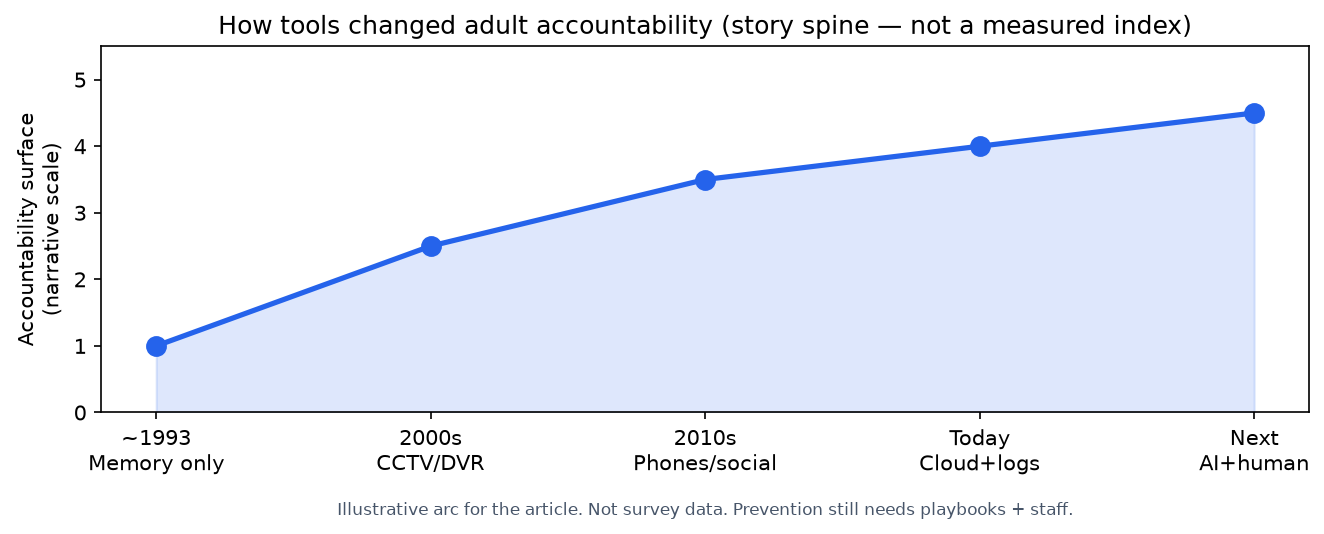
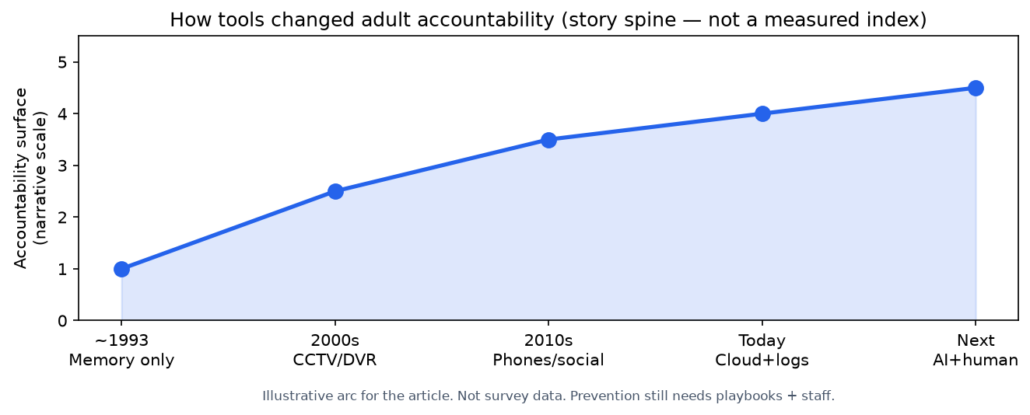
Rough eras, told as an accountability timeline — not a product history:
- ~1990s and earlier — Witnesses and memory. Almost no record. Power rarely audited.
- 2000s — CCTV and tape/DVR. Adults could be reviewed after something went wrong.
- 2010s — Phones and social video. Anyone could document. Reputation became a real consequence.
- Today — Cloud cameras, access logs, visitor systems. More audit trail. Still mostly reactive.
- Next — Analytics on live feeds that flag risk and get a human there in time. Prevention capacity — if triage exists.
CISA’s K-12 School Security Guide already places monitored CCTV in the Detect layer of layered physical security, with policies for how staff watch and what they do when a threat is seen (CISA, 2022). Detection without a playbook is forensics. Detection with trained response is prevention capacity.
Practitioner guidance makes the same gap plain: most school cameras are still not watched live; analytics can turn passive recording into proactive alerts as a force multiplier, not a force replacement (PASS, 2025).
What school video analytics research has actually achieved
Be honest about the evidence base.
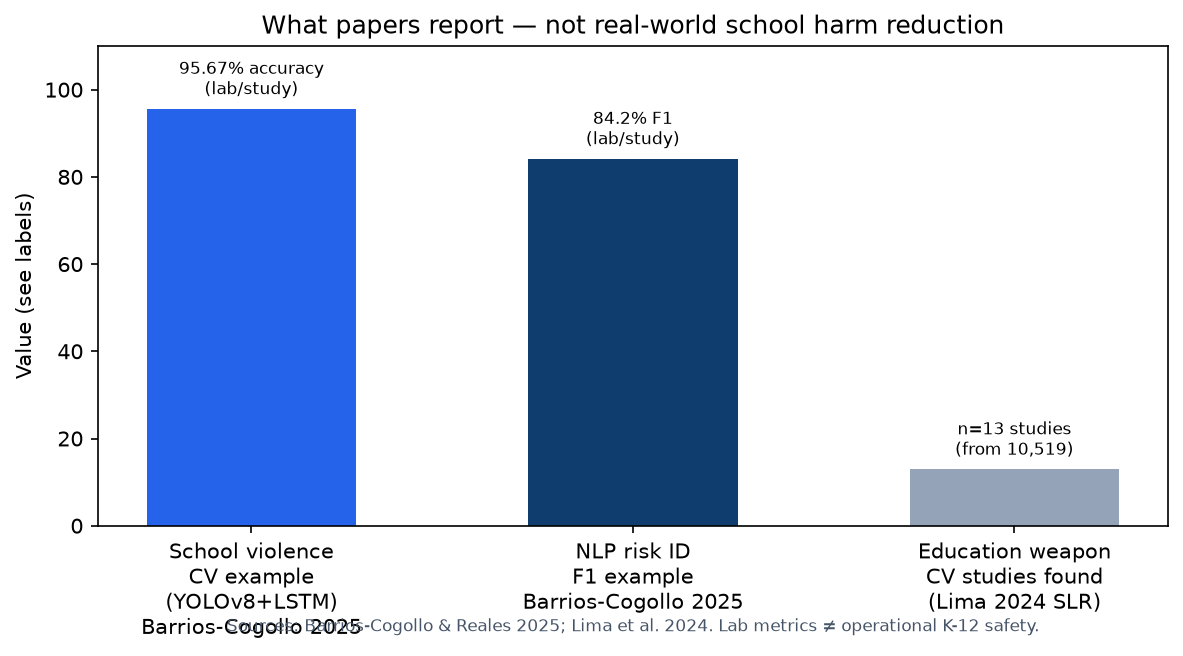
Detection tech is real. Reviews of deep learning for violence and assault in video catalog large datasets and strong laboratory accuracies (Negre et al., 2024). Comparative work on school violence detection reports example study metrics such as ~95.67% CV accuracy (YOLOv8+LSTM) and ~84.2% F1 for NLP risk identification in included papers — and argues hybrid vision/NLP/speech systems are promising if ethics are operationalised (Barrios-Cogollo & Reales, 2025). Weapon detection in educational environments is still a thin niche: one systematic review found only 13 qualifying studies from more than 10,000 candidates (Lima et al., 2024).
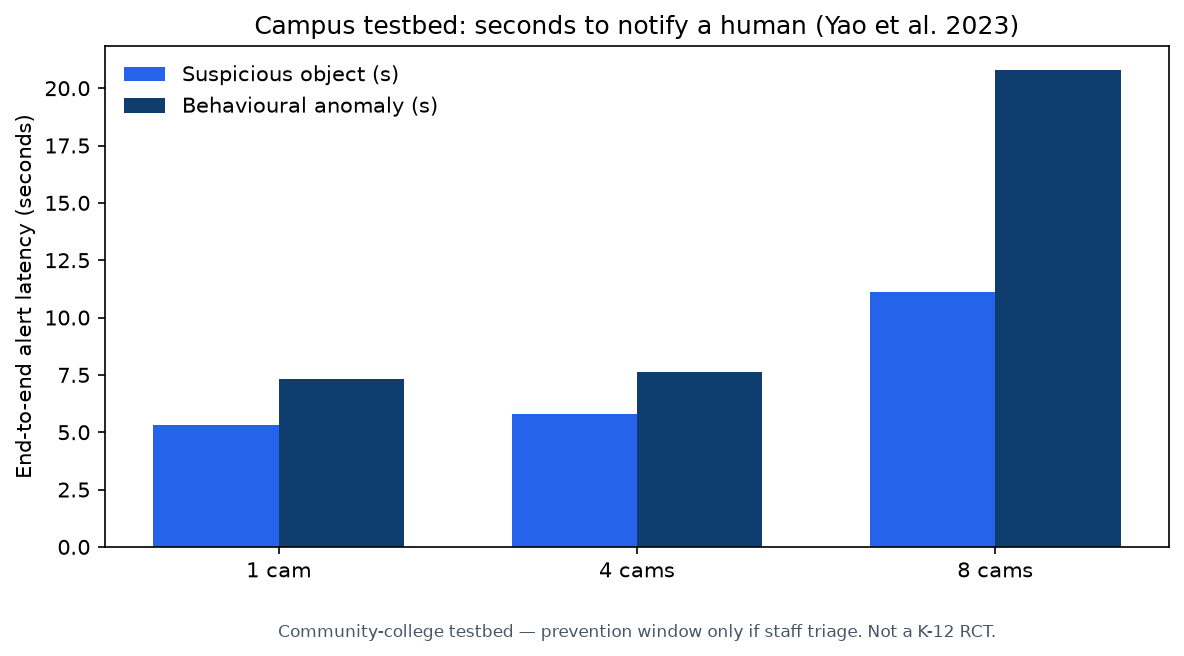
Real-time human alerting is technically feasible. A community-college testbed measured end-to-end notification latency on the order of ~5–11 seconds for suspicious objects and ~7–21 seconds for behavioural anomalies as camera count scaled from 1 to 8 (Yao et al., 2023). That is a prevention window — only if someone is ready to triage and act.
What the literature has not proven: a clean causal claim that AI video reduces assaults, bullying severity, or active-threat deaths in K-12 at population scale. High paper accuracy ≠ operational reliability in noisy corridors, playgrounds, or culturally diverse schools. False alarms are not free: they burn staff time, can trigger over-response trauma, and can feed discriminatory discipline (CISA, 2024; Citron, 2024).
So the useful claim is narrower: AI can shorten the path from a detectable event to a human decision. It does not replace climate, counselling, bystander reporting, access control, or trained adults — CISA treats those as core (CISA, 2022; 2024).
Responsible AI surveillance guidelines (before you buy a model)
If schools go toward AI-supervised monitoring, guidelines matter more than the demo reel.
- Human in the loop — AI flags; a trained adult verifies and decides. CISA’s own early-detection AI box stresses that human review remains critical and that tools are insufficient alone (CISA, 2024).
- Prevention playbooks — Every alert type needs who goes, what they do, how fast, and how to keep the response proportionate (protect / evaluate / communicate streams; avoid lockdown trauma from over-response).
- Privacy by design — No cameras in intimate spaces; short retention; tight access; parent/community transparency; FERPA-aware (or local equivalent) data plans (PASS, 2025; EPIC, n.d.). Prefer event-level Detection/Observation over Recognition/Identification of who unless you have a clear, audited need (PASS DORI ladder).
- False-positive discipline — Measure harm from false alarms, not only recall. Build review queues, appeal paths, and equity audits (CISA, 2024; Citron, 2024).
- Audit everything — Who saw what, who was alerted, what action was taken. NIST AI RMF’s GOVERN → MAP → MEASURE → MANAGE lifecycle is a workable pattern for documenting intended use, fairness/privacy metrics, oversight roles, and post-deployment monitoring (NIST, 2023; Swaminathan & Danks, 2024).
- No fear-as-pedagogy — Tech must not recreate the kick in digital form. Surveillance that teaches children they are perpetual suspects is a cultural failure even when the model scores well (Citron, 2024).
- Purpose limitation — Stay on threat-to-child / intrusion / violence early warning. The same CV stack is used for engagement, attention, and emotion scoring in classroom studies (Liu et al., 2025). Without a hard boundary, “safety AI” becomes continuous behavioural grading.
AI CCTV monitoring tool categories that make prevention viable
Categories, not a shopping list — so the stack matches the guidelines:
- Edge / on-prem video AI — Run inference close to the camera when you can; reduce shipping every frame to the public cloud; align with data minimisation.
- School-tuned behaviour / anomaly detection — Aggression, fight kinematics, person down, after-hours presence, perimeter breach, weapon-like object in view. Prefer detectable events over inferring a “risky child” from emotion scores. Expect FP risk from play, sport, special-education movement, toys, and cultural items — lab datasets rarely capture that (Lima et al., 2024; Sultani et al., 2018 as general CCTV baseline).
- Real-time alerting with location — Radio, phone, or security desk plus floor-plan location so the “seconds” Yao et al. measured are usable.
- Access control + visitor management on the same timeline — Tie door events and visitor status into the incident story; prefer credentials and human visitor process over jumping straight to facial recognition for minors.
- SOC-style triage — Borrow security-operations habits: queue, severity, escalate, close the loop, review misses and false alarms.
- Policy + training — Staff will not trust (or will over-trust) a black box. Write the playbook before the purchase (PASS, 2025).
Facial recognition and identity-linked analytics sit at the privacy cliff. Many high-value prevention alerts do not require naming a face — they require noticing an event and getting an adult there.
How this helps Victoria schools (and anywhere similar)
| Question | What we can say with sources | What we should not say |
|---|---|---|
| Can AI see violence / weapons in video? | Yes, with strong lab results and active research; education-specific weapon evidence is still thin. | “95% means your school is safe.” |
| Can alerts arrive in time to matter? | Campus testbeds show multi-second to ~20s paths. | Alerts alone interrupt harm without staff. |
| Is this doctrine or hype? | Monitored detection is already in K-12 security guidance; AI is a way understaffed sites might approximate monitoring. | AI replaces layered security. |
| What’s the biggest operational risk? | False alarms, bias, privacy/civil rights, mission creep into student scoring. | Ignore FP cost because “kids first.” |
| How do we govern a pilot? | NIST AI RMF + purpose limits + human oversight + retention + independent review. | “Pilot with marketing metrics only.” |
For Victoria (and anywhere similar): start with corridors and perimeters, public spaces, clear community notice, no intimate spaces, event-level detection first, published false-positive and equity metrics, and a kill-switch back to non-AI monitoring. Treat adult-on-child harm as in-scope for accountability — with access controls so the same system cannot become a tool of cover-up or unchecked retaliation.
If you are designing school or campus safety with humans still accountable in the loop, more on how we work is at zameni.us/services.
Closing: fear isn’t a pedagogy
In 1993, power left almost no trace, and nothing interrupted the moment. Today we can leave a trace. Tomorrow we might leave a chance — if AI is supervised, playbooks are real, and dignity stays non-negotiable.
Fear isn’t a pedagogy. Footage isn’t prevention. Prevention is a human who arrives in time, helped by tools that know their limits.
References (selected)
- Barrios-Cogollo, C., & Reales Hurtado, M. (2025). Comparative analysis of artificial intelligence techniques for the detection of school violence. CESTA, 6(1). https://doi.org/10.17981/cesta.06.01.2025.04 · https://revistascientificas.cuc.edu.co/CESTA/article/view/6418
- Citron, D. K. (2024). The surveilled student. Stanford Law Review, 76, 1439. https://review.law.stanford.edu/wp-content/uploads/sites/3/2024/10/Citron-76-Stan.-L.-Rev.-1439.pdf
- Cybersecurity and Infrastructure Security Agency. (2022). K-12 School Security Guide (3rd ed.). https://www.cisa.gov/resources-tools/resources/k-12-school-security-guide-3rd-edition
- Cybersecurity and Infrastructure Security Agency. (2024). Anonymized Threat Response Guidance: A Toolkit for K-12 Schools. https://www.cisa.gov/sites/default/files/2024-10/ATRGToolkit508_V2.pdf
- Electronic Privacy Information Center. (n.d.). Student privacy. https://epic.org/issues/data-protection/student-privacy/
- Lima, M. R., Ferreira, D. J., Dias, E. S., Mota, M. R., Chagas, A. L. B., & Lobo, P. L. S. (2024). Computer vision for weapon detection in educational environments: A systematic literature review. In Anais Estendidos do Simpósio Brasileiro de Sistemas Multimídia e Web (WebMedia) (pp. 121–128). SBC. https://sol.sbc.org.br/index.php/webmedia_estendido/article/view/30491
- Liu, Q., Jiang, X., & Jiang, R. (2025). Classroom behavior recognition using computer vision: A systematic review. Sensors, 25(2), 373. https://doi.org/10.3390/s25020373 · https://www.mdpi.com/1424-8220/25/2/373
- National Institute of Standards and Technology. (2023). Artificial Intelligence Risk Management Framework (AI RMF 1.0) (NIST AI 100-1). https://www.nist.gov/publications/artificial-intelligence-risk-management-framework-ai-rmf-10 · PDF: https://nvlpubs.nist.gov/nistpubs/ai/NIST.AI.100-1.PDF
- Negre, P., Alonso, R. S., González-Briones, A., Prieto, J., & Rodríguez-González, S. (2024). Literature review of deep-learning-based detection of violence in video. Sensors, 24(12), 4016. https://doi.org/10.3390/s24124016 · https://www.mdpi.com/1424-8220/24/12/4016
- Partner Alliance for Safer Schools. (2025). What is analytical surveillance AI technology and how can it be best utilized in today’s K-12 school environment? https://passk12.org/artificial-intelligence/what-is-analytical-surveillance-ai-technology-and-how-can-it-be-best-utilized-in-todays-k-12-school-environment/
- Sultani, W., Chen, C., & Shah, M. (2018). Real-world anomaly detection in surveillance videos. In Proceedings of the IEEE/CVF Conference on Computer Vision and Pattern Recognition (CVPR) (pp. 6479–6488). https://openaccess.thecvf.com/content_cvpr_2018/html/Sultani_Real-World_Anomaly_Detection_CVPR_2018_paper.html
- Swaminathan, N., & Danks, D. (2024). Application of the NIST AI Risk Management Framework to surveillance technology. arXiv:2403.15646. https://arxiv.org/abs/2403.15646
- Weinstein, M. (2020). School surveillance: The students’ rights implications of artificial intelligence as K-12 school security. North Carolina Law Review, 98(2), 438. https://scholarship.law.unc.edu/nclr/vol98/iss2/5/
- Yao, S., Rahimi Ardabili, B., Danesh Pazho, A., Alinezhad Noghre, G., Neff, C., & Tabkhi, H. (2023). Real-world community-in-the-loop smart video surveillance — A case study at a community college. arXiv:2303.12934. https://arxiv.org/abs/2303.12934

Leave a Reply
Want to join the discussion?Feel free to contribute!